The return of solar-powered trains is remarkably symbolic—an advancement that returns transportation to its primary energy source, the sun. Trains powered by coal and diesel, which darkened skies and altered economies, were the pinnacle of industrial advancement decades ago. With climate responsibility at the forefront, the railway sector is now drawing inspiration from the same light that formerly propelled ancient voyages and fed farms.
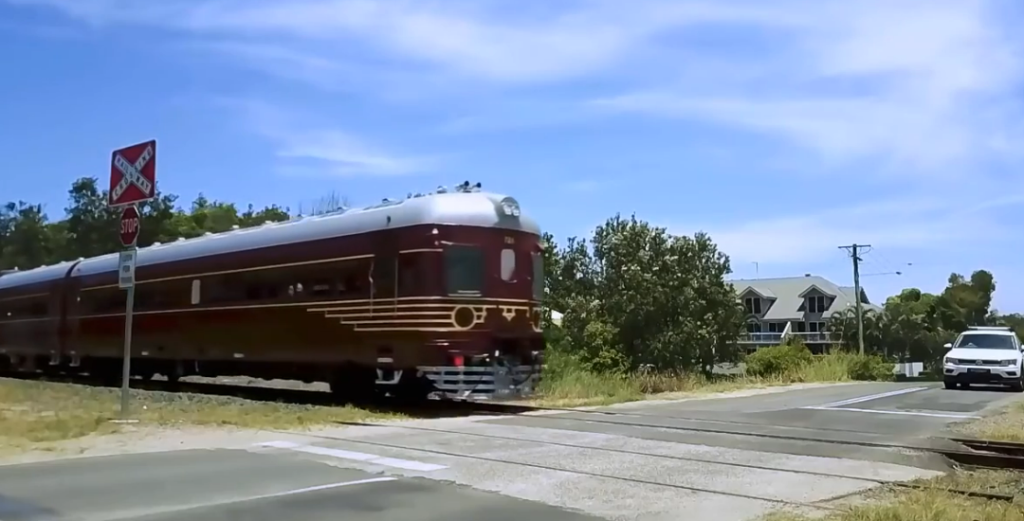
A antique carriage in Australia’s Byron Bay has subtly accomplished what many contemporary ventures are still striving for. The Byron Bay Solar Train travels a three-kilometer circuit that shimmers alongside the water and runs solely on solar power. Sunlight is captured by rooftop panels, power is stored via regenerative braking, and excess energy is returned to the local grid. The initiative seems incredibly successful—a sophisticated fusion of innovation and nostalgia that demonstrates sustainable transportation doesn’t have to appear futuristic to feel revolutionary.
Leo Murray and his group at Riding Sunbeams are pushing the limits of clean rail travel in the UK. Their proposal is especially creative since it avoids the need of conventional electrical grids by directly connecting community-owned solar farms to DC-powered train lines. A test near Aldershot shown that passenger trains could be effectively powered by sunshine, which would lower expenses and pollution. “If you’re a railway, this is the cheapest electricity you can buy,” Murray says. His statement that solar rail is now a working system that has the potential to grow encapsulates the transition from idealism to pragmatism.
Sun-Ways, a start-up company based in Switzerland, has advanced the idea by creating solar panels that can be installed across railroad tracks without interfering with train traffic. The goal of this strategy is very clear: to produce sustainable energy from underutilized locations. To reduce downtime, engineers created detachable panels that can be installed using adapted repair trains. Over 150,000 households might be powered by this system if it is fully deployed throughout Switzerland’s network. This concept demonstrates how infrastructure, which was previously solely mechanical, may now also produce energy.
| Project Name | Location | Developer/Organization | Key Feature | Outcome/Status | Reference |
|---|---|---|---|---|---|
| Byron Bay Solar Train | Byron Bay, Australia | Byron Bay Railroad Company | Fully solar-powered passenger service | Operational since 2017 | https://byronbaytrain.com.au |
| Riding Sunbeams Project | Aldershot, United Kingdom | Riding Sunbeams | Trackside solar farm powering trains directly | Pilot completed, expansion in progress | https://www.ridingsunbeams.org |
| Sun-Ways | Switzerland | Sun-Ways SA | Solar panels installed between railway tracks | Approved for national trial | https://www.sun-ways.ch |
| Indian Railways Solar Initiative | India | Indian Railways | Rooftop solar on hybrid trains and stations | Large-scale rollout across network | https://indianrailways.gov.in |
| Nevomo Magnetic Solar System | Poland | Nevomo | Electromagnetic solar-powered propulsion | Testing in Germany and India | https://nevomo.tech |
In the meantime, one of the biggest and busiest transportation networks in the world, Indian Railways, has started a bold renewable transformation. Although trains are not yet entirely solar-powered, hybrid diesel-electric units currently have rooftop panels powering information systems, fans, and lighting. The use of fossil fuels is drastically decreasing as thousands of stations switch to solar power. For rural and isolated regions, where renewable self-sufficiency is not only desirable but essential, this action is especially advantageous.
Solar train is a topic of discussion that extends beyond small-scale initiatives. It is closely related to issues of design, technology, and energy independence. Originally powered by steam, animals, and eventually oil, trains operated at the boundaries of human stamina. They are now going back to an endless source of energy that shines brightly every day. The machine that had represented industrial pollution now represents clean reinvention, making this cyclical change feel poetic.
This revival has been made possible by technological advancements. Ten years ago, solar panels were much less efficient than those used today. Batteries store energy more densely, last longer, and charge more quickly. Complex networks can now be powered by direct current without the need for costly conversion equipment thanks to increasingly intelligent grid systems. These developments have significantly increased the viability of solar-powered vehicles, closing the gap between concept and market viability.
Meanwhile, Nevomo in Poland is completely changing the definition of “solar rail.” They completely do away with locomotives thanks to their magnetic propulsion technology, which is partially powered by renewable energy. Through electromagnetic propulsion built into the rail, each freight wagon runs on its own. The end product is a remarkably futuristic and highly effective technology that can operate each wagon independently or remotely. If it works, it might significantly lower rail emissions while boosting cargo capacity.
On the other side of the Atlantic, pioneers such as Parallel Systems in the US are testing freight wagons that run on batteries and solar power. Rail freight is becoming more like a “packet network”—agile, data-driven, and self-organizing—as each car may go up to 800 kilometers on its own. By reducing reliance on lengthy diesel trains and establishing an adaptable, solar-powered transportation system, this strategy has the potential to completely transform logistics.
However, there is a more profound change in perspective that goes beyond the engineering. Solar trains are a symbol of both technology and philosophy, a dedication to making better use of what is currently available. The notion that power may be produced by tracks, stations, and even the space between lines reflects a sustainable way of thinking that is both important and progressive.
The financial benefits are just as compelling. The cost of trackside solar power is progressively declining annually, making it less expensive than grid electricity. Because electrified solar systems require less infrastructure maintenance than overhead cable installations, the savings go beyond fuel. Solar trains are unexpectedly competitive because to their affordability and endurance, especially in areas with high levels of sunlight and old grid systems.
These undertakings have significant social ramifications. They enable local communities to generate energy by decentralizing power generation. In addition to transporting passengers, a train driven by neighboring solar farms also holds the potential for self-sufficiency. That is more than just a symbolic win for nations making significant investments in sustainable transitions; it is the cornerstone of cleaner economies.
Prominent individuals have enthusiastically supported the concept as well. While Emma Watson hailed solar infrastructure as a concrete step toward a cleaner society, Leonardo DiCaprio has emphasized train electrification as a pillar of the climate solution movement. Business titans like Bill Gates and Richard Branson have referred to solar transportation as “particularly innovative,” highlighting how these developments can reinvent clean mobility without sacrificing contemporary comfort.
There are still obstacles in the way. Investing much in energy management and battery storage is necessary for scaling solar rail for large or high-speed freight transportation. Technically, switching from alternating to direct current is still difficult. With novel converter systems, AI-driven energy modeling, and enhanced materials that make panels incredibly resilient even in the face of severe rail vibrations, engineers are overcoming these challenges with increasing tenacity.
A new environment as well as a new mode of transportation are forming. Every project, from Switzerland’s alpine trains to Australia’s sunny coastline, offers insightful information on the positive intersections of technology, sustainability, and human ingenuity. Like sunlight gradually recovering the mechanical structures that were once powered by its buried leftovers, the process feels natural.