Interest in solar satellites has grown rapidly in recent years as scientists explain a notion that seems especially novel and unexpectedly feasible. Although it sounds ambitious to capture sunlight above atmospheric interference and transfer electricity to Earth via precise microwave beams, many scientists maintain that the technique is exceptionally effective when compared to conventional solar farms. These systems maintain power harvesting with a very clear view of the Sun by circling far above clouds, producing a consistency that is quite close to baseload electricity from huge plants.
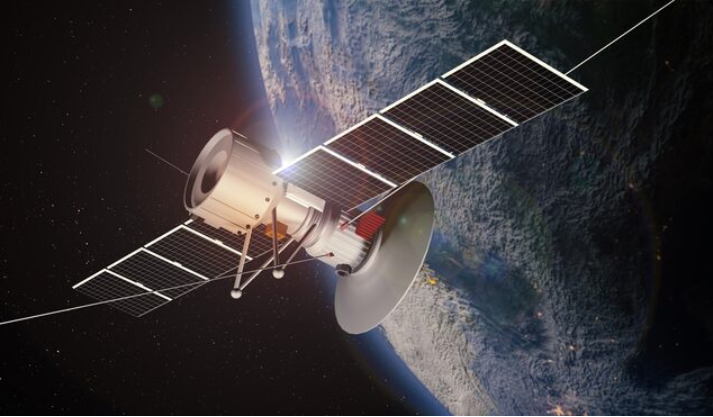
To put it simply, satellites collect sunlight, transform it into energy, and then mold that power into microwaves that go in the direction of enormous rectennas. By converting the beam back into energy, these ground receivers give grid operators a very adaptable mechanism for managing varying demand. The use of renewable energy has increased dramatically over the last ten years, and SBSP seems to be significantly better than previous plans thanks to lighter materials, less expensive launches, and enhanced beam-steering technology.
Key Information on Space-Based Solar Power
| Detail Type | Information |
|---|---|
| Technology Name | Space-Based Solar Power (SBSP) |
| Core Concept | Satellites capture sunlight in orbit and beam energy to Earth |
| Lead Developers | Space Energy Initiative, AFRL, academic partners |
| Estimated Output | Up to 2 GW per satellite |
| Notable Project | Cassiopeia satellite constellation |
| Ground Receiver | Rectennas converting beams to electricity |
| Projected Timeline | Early implementations targeted for 2035 |
| Major Advantage | Continuous, uninterrupted sunlight collection |
| Reference Link |
Advocates frequently claim that this strategy is especially advantageous for areas that face shortages at night or erratic weather. Millions of people started working remotely during the pandemic, demonstrating how delicate energy systems can become under pressure. SBSP avoids such vulnerability by using sunlight that has been captured in orbit. Due to its predictability, industry planners have been paying special attention. Each satellite can produce up to 2 GW of consistent production, which is equivalent to the capacity of large nuclear reactors.
At the center of this endeavor is the Space Energy Initiative-driven Cassiopeia project. One of the initiative’s organizers, Martin Soltau, has expressed an optimism grounded on engineering rather than fantasy, stating that the amount of solar energy that is available in geostationary orbit is significantly greater than what reaches rooftops. His team’s concept to use autonomous robots to assemble satellites seems especially creative because each module is made to fit together smoothly, resembling a mosaic of tiles in space. This strategy is simplifying processes and allowing engineers to concentrate on more complex configuration.
The project is working with universities and aerospace firms to create a research swarm that moves with the same coordinated efficiency as bees constructing a colony. With specialists honing thermal control, microwave conversion, and onboard electronics to endure the extreme temperature fluctuations of orbit, every action seems well-coordinated. Sandwich tiles that can convert sunlight into radio waves with far faster response times have previously been proven by the US Air Force Research Laboratory, supporting prototypes with remarkable durability.
Researchers stress that the intensity striking Earth is surprisingly low—less than a home microwave distributed over a vast area—despite critics’ frequent visions of beams tearing through the sky like science-fiction weapons. This particular element provides a very clear defense against safety concerns. Once implemented at scale, the technique might be very effective for medium-sized companies looking for a reliable energy source, particularly during periods of high demand. Reliable clean energy becomes crucial in the context of global warming, and SBSP fits in well with that goal.
Cost is still a big concern, but it’s evolving quickly. Deployment costs have dropped dramatically since the introduction of reusable rockets, which opens a door that was previously closed. Funding is growing because to strategic alliances, and prototypes are being tested at a rate that feels significantly faster than in the early 2000s. Businesses imagine satellites floating silently in orbit, rerouting beams to isolated towns or disaster areas in an emergency—a vision that combines human compassion with technological ambition.
Some engineers express strong feelings about the prospect of storing sunlight and directing it to the most critical locations. This viewpoint connects technical advancement with a sense of accountability, demonstrating how deeply involved teams have become. Recent energy shortages in multiple places served as a stark reminder of the urgent need for innovative solutions, which motivated researchers to sharpen their focus on orbital assembly techniques, beam precision, and module resilience.
In discussions on sustainability, celebrities and pundits have started bringing up this work, pointing out how remarkably similar SBSP is to other innovations that looked unattainable until they suddenly weren’t. In the same way that reusable rockets and electric vehicles changed popular perception, SBSP seems ready to do the same. Its promise is to provide clean power 24/7, regardless of storms, smog, or darkness—benefits that seem especially advantageous for nations attempting to expedite decarbonization.
The adaptability of the system may turn out to be one of its greatest advantages, engineers stress. A satellite might respond to needs nearly quickly by sending morning power to one continent and evening power to another due to the ability to reroute beams. Operators may create dynamic power maps by utilizing smart analytics, guaranteeing that no area experiences blackouts during times of high demand. Compared to redistributing terrestrial power across aged grids, this flexibility happens far more quickly.
The story surrounding SBSP changes from far-flung conjecture to developing infrastructure as research progresses. Researchers continue to draw attention to the increasing convergence of clean-energy planning and aerospace engineering, while prototype arrays are revolutionizing industries by automating previously unthinkable procedures. The cumulative development is remarkably successful at changing expectations for future power systems, and each achievement pushes the technology closer to deployment.
Solar satellites are developing into a reliable route for long-term energy stability through meticulous improvement. An optimistic feeling of advancement is conveyed by their capacity to beam sunlight over great distances, suggesting a time when energy will not be a limitation but rather a resource that is given with delicate accuracy. The idea gets closer to reality with every test, module, and robotic assembly stage. It feels especially creative, incredibly robust, and increasingly in line with the world’s aspirations for more stable, cleaner power.
If the rate keeps growing, SBSP has the potential to become a key component of next-generation energy landscapes, providing an incredibly efficient method of continuously powering homes, towns, and businesses. Scientists are still enthusiastic, and this optimism is evident in every update they provide, each of which raises the possibility that we may be closer than anticipated to reliably beaming sunshine over space.