As cities become denser and environmental pressures increase, floating solar farms have emerged as a remarkably effective solution to an energy landscape that has been stretching itself thin trying to find space for growth. They are now reshaping conversations about climate solutions in ways that feel particularly innovative. Their recent growth has been quite comparable to how offshore wind started to acquire popularity ten years ago, gradually establishing itself until abruptly becoming ubiquitous. These solar platforms completely avoid land conflicts by floating over reservoirs and lakes, utilizing surface area that is usually underutilized and providing a very effective substitute that is surprisingly inexpensive and incredibly resilient for large-scale installations.
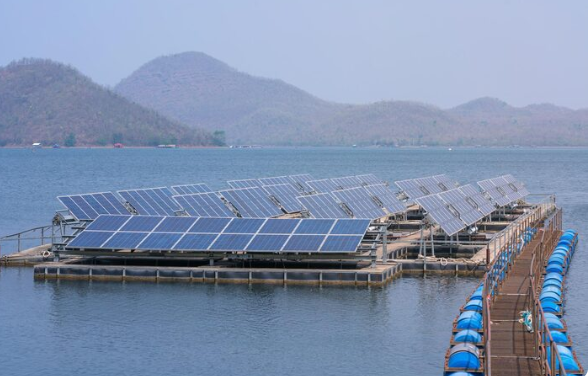
Because floating solar offers a number of advantages that regular solar farms cannot match, engineers and public authorities are adopting it with noticeably greater excitement as the demand for renewable energy grows worldwide. When it comes to energy output, FPV systems outperform panels that are placed on dry ground and exposed to direct heat by utilizing the natural cooling that water provides. The use of renewable energy has increased dramatically over the last ten years, and floating solar has steadily established itself as a reliable, steady driver in that growth, attracting interest from both commercial utilities and governments looking for simple, scalable solutions.
| Key Information | Details |
|---|---|
| Technology | Floating Solar Farms (Floating Photovoltaics / FPV) |
| Primary Purpose | Renewable energy production on water surfaces |
| Benefits | Land conservation, improved efficiency, reduced evaporation |
| Leading Regions | China, India, Brazil, Singapore, Africa |
| Notable Reference |
Early FPV pioneers discovered that these water-based systems were especially helpful for areas struggling with land constraints by working with researchers throughout Asia and Europe. One example of how a crowded city can increase its renewable footprint without interfering with housing or food production is Singapore’s Tengeh Reservoir facility. The nation created a floating solar network through strategic alliances, which today serves as the backbone of its clean-energy framework. This network streamlines operations and frees up land for other purposes. Standing close to the serene, shimmering surface, it’s easy to understand why the project director referred to the panels as “a quiet extension of the city.”
Solar arrays are secured to buoyant platforms composed of materials designed to withstand heat, storms, and continuous motion in order for floating photovoltaic systems to function. As designers move to modular designs that fit expansive lakes or constricted reservoirs, the technology has become immensely adaptable, producing energy clusters that resemble a swarm of bees working in unison. By enabling specialists to remotely monitor performance using smart sensors that continuously measure efficiency, water temperature, and structural movement, this evolving architecture has greatly decreased the maintenance issues that early adopters originally feared.
China has been the most aggressive supporter of floating solar, converting man-made lakes and abandoned coal mines into enormous FPV power plants. The Dezhou project, which spans a vast expanse of reflective water, has come to represent the nation’s fixation with clean energy. Its scope points to a time when hybrid systems—hydro providing backup at night and solar supplying electricity during the day—will be able to stabilize regional grids in remarkably distinct and well-coordinated patterns. The transformation was described as “a rare moment when technology gives something back” by the engineers, who also mention the emotional shift that took place when locals witnessed a filthy industrial site turn into a clean power source.
Installing floating solar panels on thermal plant reservoirs has proven to be especially successful in achieving India’s ambitious energy goals. Indian teams used advanced analytics to improve their hybrid systems, saving millions of liters of water annually and drastically lowering evaporation at locations where cooling requires water. These initiatives have an effect on the surrounding community that is quite comparable to shade trees planted along sun-baked roads: relief, resilience, and a subtle reminder that progress can be delicate in its touch.
By installing FPV panels over massive hydroelectric reservoirs that span the Amazon basin, Brazil has chosen a new approach. Large grids are already supported by these waterways, so adding floating solar results in an integrated system that uses dam releases more sensibly and stores electricity more intelligently. Brazil’s early floating solar clusters showed how clean power could sustain a region even as daily consumption patterns changed during the epidemic, when electricity demand fluctuated wildly. The hybrid system’s seamless operation, which engineers later described as “a conversation between water and sunlight,” was their biggest surprise.
FPV has emerged as a particularly creative remedy for rural communities facing water scarcity throughout Africa. Governments have made lowering evaporation a primary priority in light of global warming, and floating panels provide amazingly effective shade for reservoirs, protecting supplies. The most obvious example of how floating solar has improved local networks, enabled irrigation projects, and supported fish farming is Ghana’s Bui Reservoir. Despite the poetic nature of the statement, the residents’ description of the panels as the lake’s guardians highlights how profoundly the technology is changing local connections to electricity and water.
However, there is some friction associated with the rise of floating solar. According to ecologists, poorly designed installations have the potential to change aquatic ecosystems by preventing creatures below the surface from receiving sunlight. Many of the most successful FPV farms began with gradual, cautious rollouts that struck a balance between innovation and ecological sensitivity. Developers may guarantee safe installations that safeguard delicate environments by incorporating environmental studies early on. Designers frequently draw attention to the expanding relationship between conservation and energy planning in workshops with local fishermen, reminding communities that environmental stewardship should be strengthened rather than replaced by floating solar.
The financial problem is still as complicated. Specialized anchors, corrosion-resistant parts, and safety features are necessary for FPV, which raises the initial cost but usually pays off in the form of increased energy output and noticeably longer lifespan. Public-private partnerships have grown dramatically with the introduction of new climate-driven funding initiatives, relieving governments of the burden of bearing these expenses alone. Many analysts now contend that because floating solar avoids the land-rights issues that often impede traditional solar farms, it might become a very dependable option for grid planning.
There is a certain hope in the personal narratives that come from FPV sites. According to a technician at one reservoir in Kenya, when she first crossed the floating platforms, she experienced an unanticipated sense of tranquility, as though she were entering a future where energy generation was subtly integrated into the surroundings. Her reflection reflects a larger cultural change: as floating solar develops, it encourages a picture of advancement that is more incorporated into everyday life and seems less invasive.