A rumor about a “mysterious solar patent” that promises to transform energy as we know it has been making the rounds in research labs and financial circles in recent months. The idea isn’t fantasy; it’s anchored in tangible breakthroughs in materials science that have moved from university labs into private patent filings. These advancements are especially intriguing since they raise the possibility that solar energy may soon be incredibly efficient and reasonably priced.
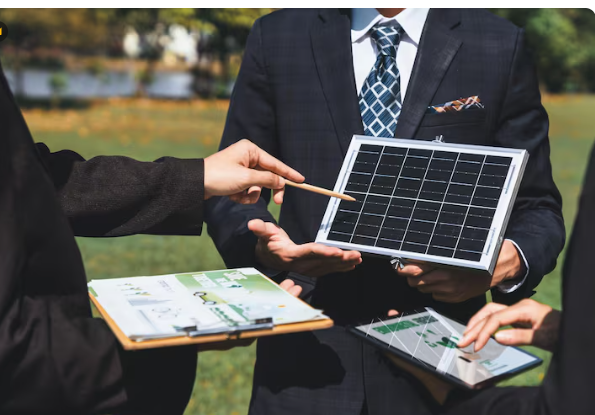
Perovskite solar cells are at the heart of this silent revolution. Since their initial conception in Japan, they have emerged as the pinnacle of next-generation photovoltaics. These materials are thin, lightweight, and flexible, allowing them to coat surfaces that standard panels could never adapt to. Scientists have pushed tandem perovskite-silicon cells beyond 30% in the last ten years, surpassing previously unthinkable efficiencies that were thought to be unreachable just a few years ago.
Key Facts About the Solar Patent Breakthrough
| Aspect | Description |
|---|---|
| Central Discovery | Advanced solar materials like perovskite, quantum dots, and titanium-based panels could redefine how energy is generated and stored. |
| Efficiency Potential | Some prototypes already surpass 30% efficiency in lab settings, notably higher than standard silicon panels. |
| Industrial Interest | Companies like Oxford PV, Swift Solar, and multiple university labs are racing to commercialize these materials. |
| Possible Applications | Lightweight, flexible panels for windows, vehicles, and wearable tech that could generate power from ambient light. |
| Reference |
Instead of being forged in energy-intensive furnaces, these cells can be printed at low temperatures by utilizing simpler chemical compositions. That makes production not only faster but much cheaper, a shift that could democratize solar adoption. Compared to conventional silicon technologies, the process is unexpectedly sustainable due to its great material efficiency. One day, sunlight could be easily captured by cars, drones, and even windows of skyscrapers.
Another exciting development that coincides with this accomplishment is quantum dot technology. The minuscule semiconductor particles known as quantum dots have the nearly miraculous capacity to adjust how much energy they absorb. They can collect various sunlight wavelengths, such as low light or interior illumination, by changing their size. This could transform consumer electronics and architectural architecture by enabling future solar devices to continue producing energy even on overcast days or in artificial illumination.
Practically speaking, quantum dots might make it possible for solar-powered smartphones or energy-storing and releasing fibers for clothes. Because it eliminates the constraints of location and exposure to sunshine, researchers find this concept especially novel. It’s no longer science fiction to picture a solar backpack charging your laptop as you go down a shaded street.
Titanium-based solar material is another intriguing candidate for the “mysterious patent” notion. This method, which was created by experts in Tokyo, uses titanium dioxide and selenium in place of silicon to produce panels that are incredibly dependable in challenging circumstances. They can function at high temperatures, are resistant to corrosion, and are remarkably resilient—even in desert or marine environments. Early laboratory experiments suggested that these materials might be up to a thousand times more energy-dense under ideal circumstances, though this was rather contentious. The consequences are especially startling, even though that figure is still theoretical.
These innovations occur at a critical juncture as pressure to decarbonize energy systems increases. Despite being widely used, traditional solar panels still have limited efficiency, expensive production costs, and a heavy reliance on rare minerals. A new stage of development is marked by the shift to flexible, affordable, and higher-yield materials; in this stage, energy may become as plentiful and widely available as Wi-Fi.
It is not implausible that a “mysterious patent” might upend international electricity markets. From transistors to lithium-ion batteries, revolutionary inventions in previous decades began as inconspicuous patents and eventually grew into trillion-dollar industries. Here, the same thing might occur. The competition to protect intellectual property has intensified due to increased investment from IT corporations and countries striving for energy independence.
As remote work changed how industries functioned throughout the pandemic, solar technology subtly progressed. Startups thrived, scholarly publications increased, and private investments increased. While their creators look for funding or regulatory approval, many of these patents are still protected by secrecy agreements. The phrase “mysterious solar patent” originates from the secrecy surrounding these submissions, which heightens their mystique.
The rate of convergence is what makes this era very comparable to the early internet boom. Researchers in data-driven energy modeling, materials science, and nanotechnology are working together in ways never seen before. Solar companies are quickly optimizing material combinations that would have taken years to test manually by combining AI design tools with molecular engineering through strategic collaborations. Reducing research cycles and increasing efficiency records are two notable benefits of this combination.
According to some experts, solar gadgets may become more than just energy sources in five years—they may become an integral part of everyday life. Solar fabrics, self-charging cars, and transparent panels integrated into glass facades have the potential to revolutionize the way energy interacts with human surroundings. The change would provide decentralized power without the need for expensive grids, which would be especially advantageous in areas with little infrastructure.
But there are still a lot of difficulties. Despite their efficiency, perovskite materials deteriorate in the presence of heat and moisture, shortening their useful life. Safer, more scalable production techniques are still needed for quantum dots. Despite its durability, titanium-based solutions require improvement to become affordable for the general public. Despite these obstacles, experts are incredibly optimistic because, as technology advances, these barriers are getting smaller every year.
Investors are paying attention. Startups that promise cleaner, lighter, and smarter panels are receiving millions of dollars from climate tech venture funds. Oxford PV and Swift Solar are two companies that have already garnered international attention by proving that commercialization is not only feasible but also imminent. Testing facilities have significantly improved as a result of the money infusion, enabling greater data validation and quicker iterations.
To speed up adoption, governments are also coordinating their policies. Countries are setting themselves up to spearhead this technological revolution by providing incentives for local production and renewable energy research. In their clean-energy plans, the US, Japan, and a number of European nations are giving solar innovation top priority. This partnership between private innovation and public policy is incredibly successful in laying the groundwork for the upcoming energy revolution.
Not only will this enigmatic solar patent—or rather, the network of discoveries it represents—change the way energy is produced, but it will also alter how people view it. Solar energy may become a commonplace feature incorporated into consumer electronics, architecture, and textiles rather than a specialist infrastructure expenditure.
The ramifications include culture, lifestyle, and creativity in addition to economics and technology. Homes that illuminate sustainably after sunset, artists creating light-generating artworks, or musicians playing on self-powered stages—all of these examples point to a future where energy and design are seamlessly integrated.