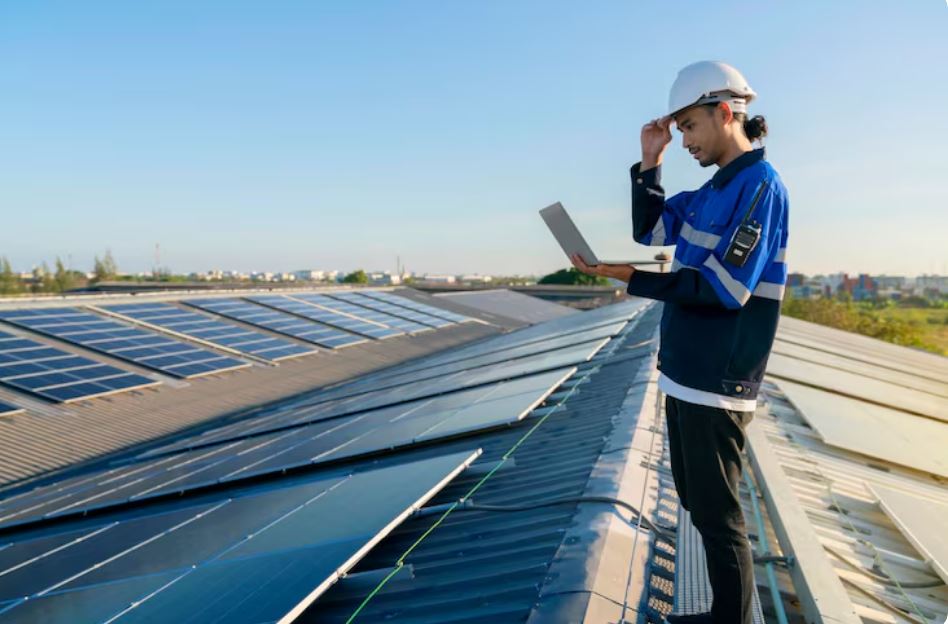
The phrase “running out of roofs” refers to the unexpectedly reached economic ceilings in the solar industry rather than actual physical space. Rooftop solar, which was once a representation of clean ambition and independence, is currently under pressure from changing regulations, more stringent budgets, and cautious homeowners who are holding out for better times.
Rooftop solar has experienced a golden age in recent years. Climate-conscious customers, generous incentives, and declining equipment costs drove installations to all-time highs. However, that pace has noticeably slowed. Analysts claim that interest rates are the main offender. The economics of installing panels became less attractive as borrowing costs increased. What was once thought of as a wise investment now seems like a luxury buy.
| Detail | Information |
|---|---|
| Core Challenge | Rooftop solar installations declining due to high interest rates, reduced incentives, and slower consumer demand |
| Major Market Affected | California, following the shift to NEM 3.0 policy |
| Key Drivers | Financing barriers, policy cuts, utility resistance, material and labor cost increases |
| Leading Analysts | Zoë Gaston (Wood Mackenzie), Deepak Rajagopal (UCLA), Gilbert Michaud (Loyola University) |
| Market Contraction | 13% drop in U.S. rooftop solar installations in 2024 |
| Forecasted Recovery | Expected rebound of 13% in 2025 as financing improves |
| Industry Trend | Transition from small residential projects to utility-scale solar farms |
| Reference Source | CNET – The Rooftop Solar Industry Is Struggling, but It Isn’t Collapsing (cnet.com) |
Zoë Gaston of Wood Mackenzie claims that there will be a “correction, not collapse” in the residential solar market. According to her research, there will be a 13% contraction in 2024 but a slight recovery in 2025 as interest rates progressively decrease. However, this pause feels like a storm after the calm for a lot of businesses. Their growth models were not designed for survival, but for expansion.
In California, which has long been at the center of the rooftop solar revolution in America, the situation is particularly apparent. Homeowners were paid significantly less for returning excess energy to the grid after the state implemented NEM 3.0. Overnight, the math was altered. The ten-year payback period was extended to fifteen or more years. As prospective clients changed their minds, installers reported a large number of cancellations.
According to UCLA energy economist Deepak Rajagopal, “California’s policy didn’t end rooftop solar—it ended the perception that it was a guaranteed win.” Homeowners had been encouraged to invest for years by the prospect of generous net metering. Confidence grew as those returns decreased.
The drop-off was abrupt and spectacular. In some areas, sales fell by almost half. Already leery of decentralized energy, utility companies quietly rejoiced in the slowdown. They had long found rooftop solar annoying because it reduced profits and redistributed grid costs. Their lobbying efforts have made residential installations less accessible by pushing for stricter permitting requirements and higher connection fees, especially in states like Arizona and Nevada.
The cost of materials started to gradually increase at the same time. Although solar modules are still surprisingly inexpensive, other costs, such as labor and insurance, have been rising steadily. The so-called “soft costs” of rooftop solar now make up nearly half of the total cost. Even the most environmentally conscious homeowners may find their patience tested when projects take months to complete due to permits, inspections, and interconnection delays.
McKinsey & Company claims that the slowdown is a correction following years of unsustainable acceleration rather than a crisis. Rooftop installations worldwide increased by about 30% a year between 2020 and 2023, a rate that was challenging to sustain. Many businesses overinvested in capital and made aggressive hiring decisions as they scaled up too quickly. The structure broke under its own weight when interest rates tripled.
However, innovation has not been stifled by the downturn. Because community and utility-scale solar farms offer better economies of scale and fewer bureaucratic obstacles, businesses across the nation are switching from residential projects to these types of projects. Instead of a retreat, the change represents a strategic recalibration. Additionally, it is developing new business models that have the potential to revolutionize energy access in the upcoming ten years, such as cooperative grids, shared solar, and hybrid storage solutions.
Loyola University Chicago environmental policy professor Gilbert Michaud sees this shift as a normal cycle. He declares, “We’re not running out of rooftops.” “Our easy wins are running out. More participation and more intelligent policy will be needed in the next stage. His argument highlights a fundamental reality: residential solar energy is still feasible, but only if consumers, lenders, and regulators come together again.
This slowdown’s emotional undertone is reminiscent of the recent hesitancy in the electric vehicle market. Early excitement gave way to logistical exhaustion due to institutional resistance, shifting subsidies, and complicated financing. However, there is still hope for the future, just like with EVs. Once the macroeconomic conditions improve, the Inflation Reduction Act, which offers significant federal tax credits, may still revitalize rooftop solar.
The public’s attitude hasn’t changed either. According to Forbes Home surveys, over 80% of solar homeowners are still happy and would suggest installation. These days, a lot of people combine panels with battery storage to increase energy resilience and independence. In areas where wildfires or unstable grids are common, where homeowners increasingly see solar as a safety measure rather than a luxury, this combination is especially advantageous.
In the meantime, the actual design of energy policy is changing. States are experimenting with local energy-sharing networks, virtual net metering, and time-of-use rates. With the help of online resources like SolarApp, created by the National Renewable Energy Laboratory, Sunrun, the biggest residential installer in the nation, has been aggressively advocating for standardization. It could drastically cut installation costs and permitting times in thousands of local jurisdictions if it is widely implemented.
The industry faces social as well as technical challenges. Black and Hispanic-majority neighborhoods have significantly fewer rooftop systems, even when income levels are similar, according to a UC Berkeley study. The “solar gap” draws attention to more significant disparities in financing, homeownership, and confidence in emerging technologies. Researchers contend that closing that gap could increase market share and guarantee that the advantages of clean energy are distributed more fairly.
The rooftop solar movement is still a vital representation of personal empowerment, even with the temporary slowdown. The notion that a household can produce its own energy in a clean, quiet, and autonomous manner still has a lot of emotional resonance. It is still promoted as a lifestyle change and a climate solution by cultural icons like Leonardo DiCaprio and Shailene Woodley. Their message strikes a chord because it links technology to virtues like hope, stewardship, and independence.
Therefore, the present growth pause is a time for introspection rather than a sign of failure. The early adopters, the advantageous policies, and the low-interest loans are all gone. All that’s left is the more difficult task of restoring trust and streamlining procedures so that renewable energy feels both morally right and feasible.
Optimism quietly reappears as the industry rebalances. It is anticipated that interest rates will decline. Incentives under policy will develop. More homeowners will have access to new financing options. It’s a season of moderation for the time being, but not of retreat. The rooftops remain, patiently awaiting the next phase of clean energy advancement under the sun.